
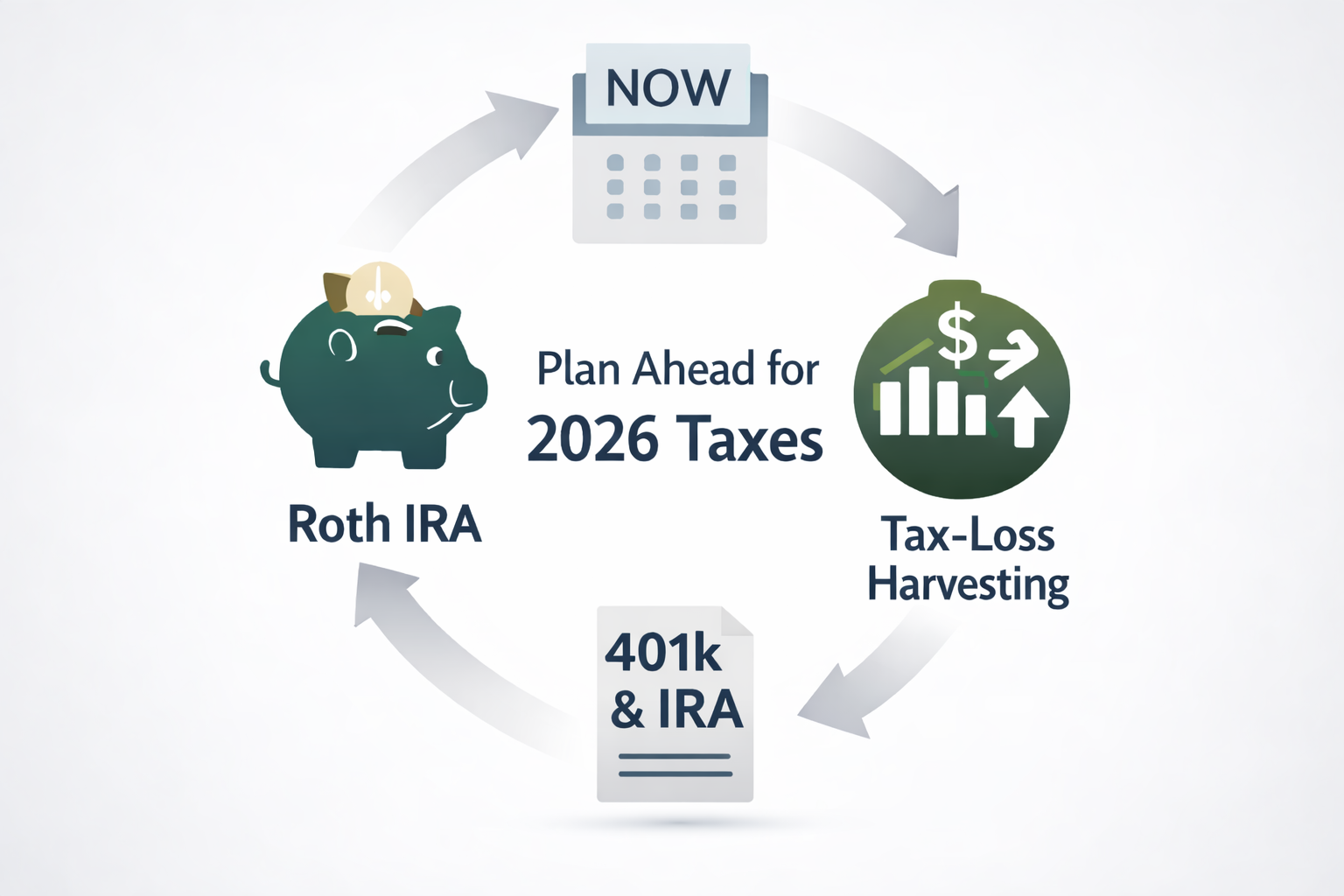
Tax Planning Moves to Take Now for a Better 2026 Return
For many taxpayers, taxes feel like something that only matters in April. But the reality is that most meaningful tax decisions are made long before tax filing season ever arrives.
At Delta Wealth Advisors, we see again and again that the biggest opportunities for improving a client’s tax outcome come from timing, coordination, and intentional decisions throughout the year — particularly for retirement contributions, investment positioning, and year-round strategy. Acting early gives you more flexibility and more time for compounding and tax-efficient growth to work in your favor.
If you’re not sure which of these moves apply to your situation, a proactive planning review earlier in the year can make a meaningful difference.
How Can Bonuses Impact 401(k) Contributions?
The IRS increased 401(k) contribution limits again for 2026, giving savers the opportunity to defer more income on a tax-advantaged basis. 2026 contribution limits have increased to $24,500 from $23,500. IRA contribution limits have increased to $7,500 from $7,000.
For high earners and executives, this contribution limit can be reached quickly — especially if a January bonus pushes total compensation higher than expected. (Reminder: many 401(k) plans allow for different contribution %'s for regular payroll and bonuses.)
One wrinkle many people overlook is how their employer’s plan handles matching contributions. Some plans require you to make contributions in each pay period in order to receive the full company match. In those cases, front-loading your 401(k) early in the year could actually reduce matching dollars.
Other plans allow you to max out early and still receive the full match — but only if the plan document says so. Reviewing the plan’s Summary Plan Description is the only way to know which rules apply.
Mistiming 401(k) contributions can lead to missed employer matches and excess contributions that require corrections.
A review of your pay structure, bonus timing, and plan rules can help you maximize both tax savings and employer dollars — not just your own contributions.
When Should I Make My Backdoor Roth IRA Contribution?
Many people know that Roth IRA contributions can be made up until the tax filing deadline — but waiting until April means missing out on potential growth during the early part of the year when markets historically trend upward.
By making your backdoor Roth IRA contribution in January instead of next spring, you give your investment more time to grow tax-free.
For example, the stock market rose approximately 16% last year. For a married couple making backdoor Roth contributions, that equated to roughly $2,000 of growth that was completely tax-free — simply because the contribution was made earlier rather than delayed.
A couple of things to keep in mind with backdoor Roth contributions:
- You may be subject to the pro-rata rule depending on existing IRA balances.
- Timing and sequencing matter to avoid unintended taxable income.
Backdoor Roth contributions are simple in concept but technical in execution — and they’re the kind of move where coordinated tax and investment planning pays dividends.
When Should Investors Complete Tax-Loss Harvesting?
Market volatility isn’t just noise — it can be a planning opportunity.
When individual securities experience meaningful declines, that can create chances to realize losses that offset capital gains and, up to $3,000 of ordinary income per year if gains are limited.
Over the past several decades, the market has historically seen mid-year pullbacks of roughly 14%, meaning these opportunities aren’t rare — they happen often enough that active monitoring can add value.
A recent example illustrates the point well: news that Medicare Advantage premiums may be flat for 2027 drove one UnitedHealth Group's stock down nearly 20% in one day. For investors with that stock in their portfolio, that kind of move can present a clear tax-loss harvesting opportunity:
- Sell the individual stock at a loss
- Buy a related sector ETF to maintain exposure to investment thesis
- Repurchase the stock after 31 days to avoid wash sale disallowance
Realizing stock losses early in the year can be used in two ways. As previously mentioned, $3,000 of losses can be written off against ordinary income per year. Since ordinary income rates are often higher than capital gains, this tax delta can equate to $1k less in taxes paid for high-income earnings.
Additionally, investors with realized losses early in the year can use those losses to offset gains later in the year. Tax-efficient investors recognize the importance of timing taxable gains, and by having losses, investors can offset those gains to minimize tax liabilities in the current year.
Ongoing portfolio monitoring combined with thoughtful tax planning can turn market volatility into a long-term advantage — but you have to be looking for it.
Bringing It All Together
None of these strategies exist in isolation. The greatest tax planning value comes from coordinating retirement savings decisions, investment positioning, and tax strategy throughout the year — not just at filing time.
If you want a proactive 2026 tax strategy instead of reactive tax filing, this is exactly the type of planning conversation we help clients with.